How Close Can You Get to the Turtles?
How close can you get to turtles in Hawaii: NOAA's 10 feet (3 m), judging it with your hand, why touching and feeding are illegal, the penalties, how to report.
Stay at least 10 feet (3 meters) from a turtle, in the water and on the sand: that is the distance NOAA and the state of Hawaii recommend. It is guidance rather than a legal line, but the law behind it is real. Hawaii’s green turtles are a threatened species, and the state’s natural-resources department says touching or feeding a turtle in any way is a disturbance and illegal; under state law a first offence is a misdemeanor with a fine of at least $250, up to a year in jail, or both. In the water: float still, let the turtle choose its path, and never block its way to the surface. Hawaii Apex Charters runs its six-guest trip on a strict hands-off rule, from $104 a person (checked November 2026).
The calendar above is Hawaii Apex Charters’ 90 minutes for six guests at most, with a briefing on Hawaiian culture and wildlife before you get in and a rule against touching any marine life: turtles, reef fish, urchins or starfish.
10 feet in the water
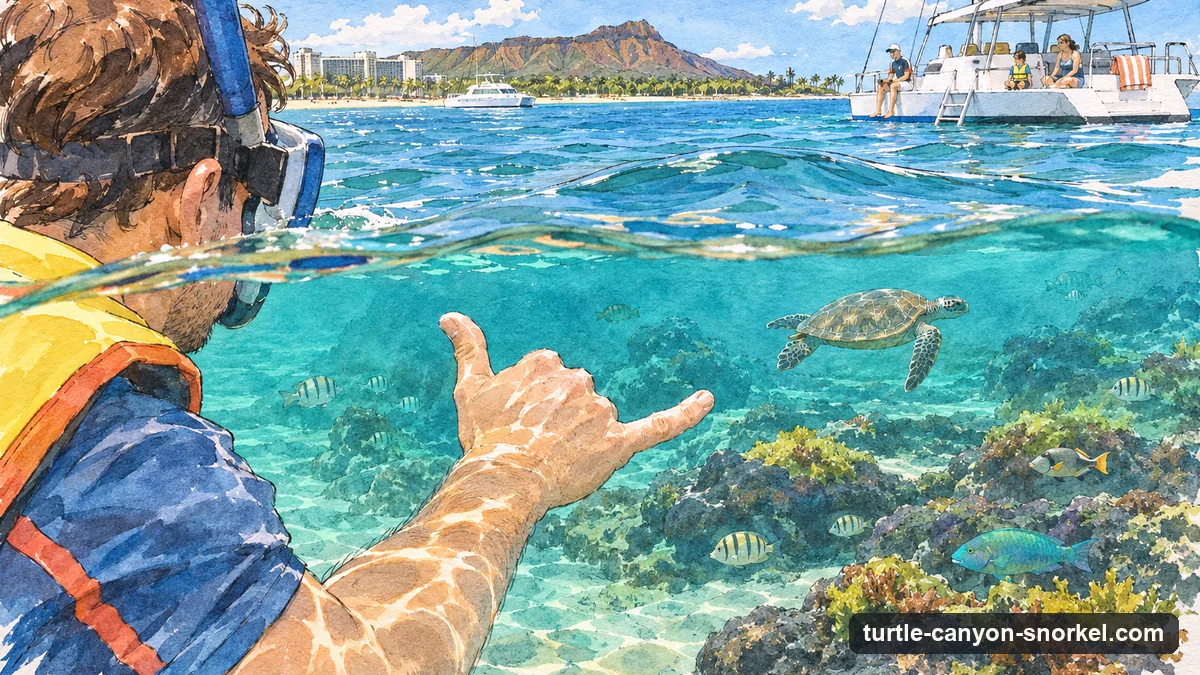
Ten feet is hard to judge when you are floating face-down. A rough check from the surface: hold out a shaka at arm’s length; if the turtle’s whole body, seen from the side, fits between your thumb and little finger, you are about far enough away. If it is bigger than your hand, back off.
- Float to the side, not on top of the turtle. A turtle under you has to come up through you to breathe.
- Do not dive down on a resting turtle or follow one along the reef.
- If a turtle swims toward you, stay still and let it pass. The state’s advice is to ignore it so it moves on undisturbed.
- No selfies with a turtle, no hands, no sticks, no feeding. NOAA asks that nobody swim with, ride, pet, touch or try to interact with a sea turtle in the wild.
What the law says
| Rule | Who sets it | What it says |
|---|---|---|
| 10 feet (3 meters) | NOAA Fisheries and Hawaii’s Division of Aquatic Resources | The recommended viewing distance in Hawaii, on land and in water. NOAA says in writing that it is not a legal, enforceable boundary. |
| No touching, no feeding | Hawaii DLNR | Touching or feeding a turtle in any way is a disturbance and illegal. |
| No “take” | The federal Endangered Species Act and Hawaii’s HRS chapter 195D | “Take” includes to harass, harm or pursue a threatened species, or to attempt it. |
| Penalties | HRS 195D-9 | A first offence is a misdemeanor: a fine of at least $250, up to a year in jail, or both. A repeat is a class C felony with a fine of at least $1,000. The state can also impose administrative fines of $2,500 to $5,000 for a first violation. |
Hawaii’s green turtles, of the Central North Pacific population, are listed as threatened, not endangered; the hawksbill, rare in these waters, is the endangered one.
On the boat
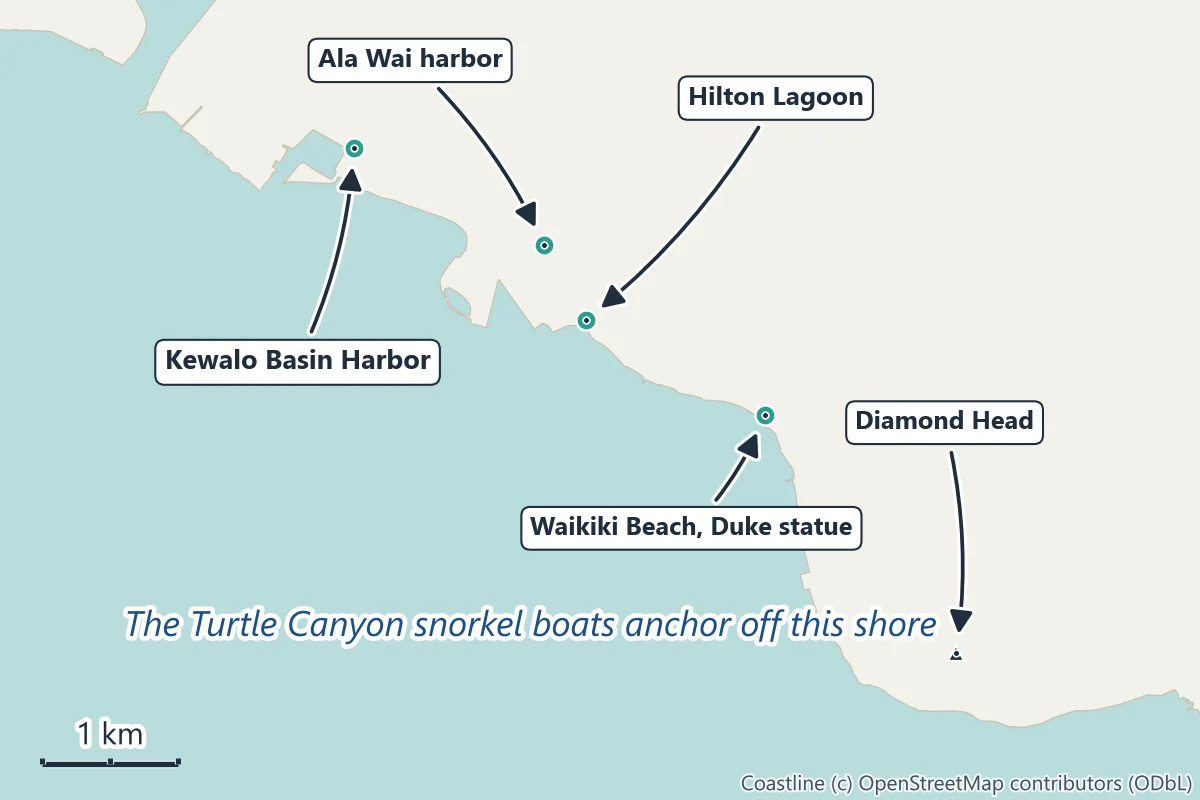
NOAA asks boats to go at “turtle safe” speeds of 5 to 10 knots near harbors and over shallow reef, and to put the engine in neutral if a turtle comes close. The state also warns that feeding turtles can lead to dangerous behavior, as they start to associate boats with food. A boat that throws food in the water to draw turtles is breaking the rules, not offering a better show.
Other animals on the way
- Spinner dolphins: federal law bans swimming with or approaching Hawaiian spinner dolphins within 50 yards, in waters within 2 nautical miles of the main islands.
- Humpback whales (November to May): it is illegal to approach within 100 yards.
Sunscreen
Since January 1, 2021, Hawaii has banned the sale of sunscreens containing oxybenzone or octinoxate without a prescription. “Reef safe” on a label is not regulated by any agency, so read the ingredients; DLNR points to mineral filters such as zinc oxide or titanium dioxide, and a rash guard or wetsuit means less sunscreen in the water.
If you see a problem
- An injured, entangled or nesting turtle: NOAA’s statewide Marine Wildlife Hotline, (888) 256-9840.
- Someone harassing a turtle: DLNR’s enforcement division, DOCARE, at (808) 643-3567, or RespectWildlife@noaa.gov.
Boats that keep their hands off
Hawaii Apex Charters: Turtle Canyon Snorkel for Six, Hands-Off
Hawaii Apex Charters: a wildlife briefing, lifeguard-certified guides and a strict no-touching rule for six guests at most.
Check dates →Hawaii Ocean Charters: Small-Group Turtle Canyon Snorkel with a Guide in the Water
Hawaii Ocean Charters: a briefing on reef etiquette, then an hour with a guide and a safety diver; touching marine life not allowed.
See the small-group snorkel →Living Ocean Tours: Guided Turtle Canyon Snorkel
Living Ocean Tours: a safety talk and snorkel lesson, then guides who swim with the group.
See the guided snorkel →Prices, ratings and review counts from the listings (GetYourGuide checked November 2026; Viator checked November 2026). Operators price by date and season, so treat the figures as the shape of the market, not a quote.
More Trips with Open Dates
More Turtle Snorkels Off Waikiki with Open Dates
Turtle snorkels and catamarans with live availability. Times and cancellation terms are on each listing.
A Hands-Off Snorkel for Six
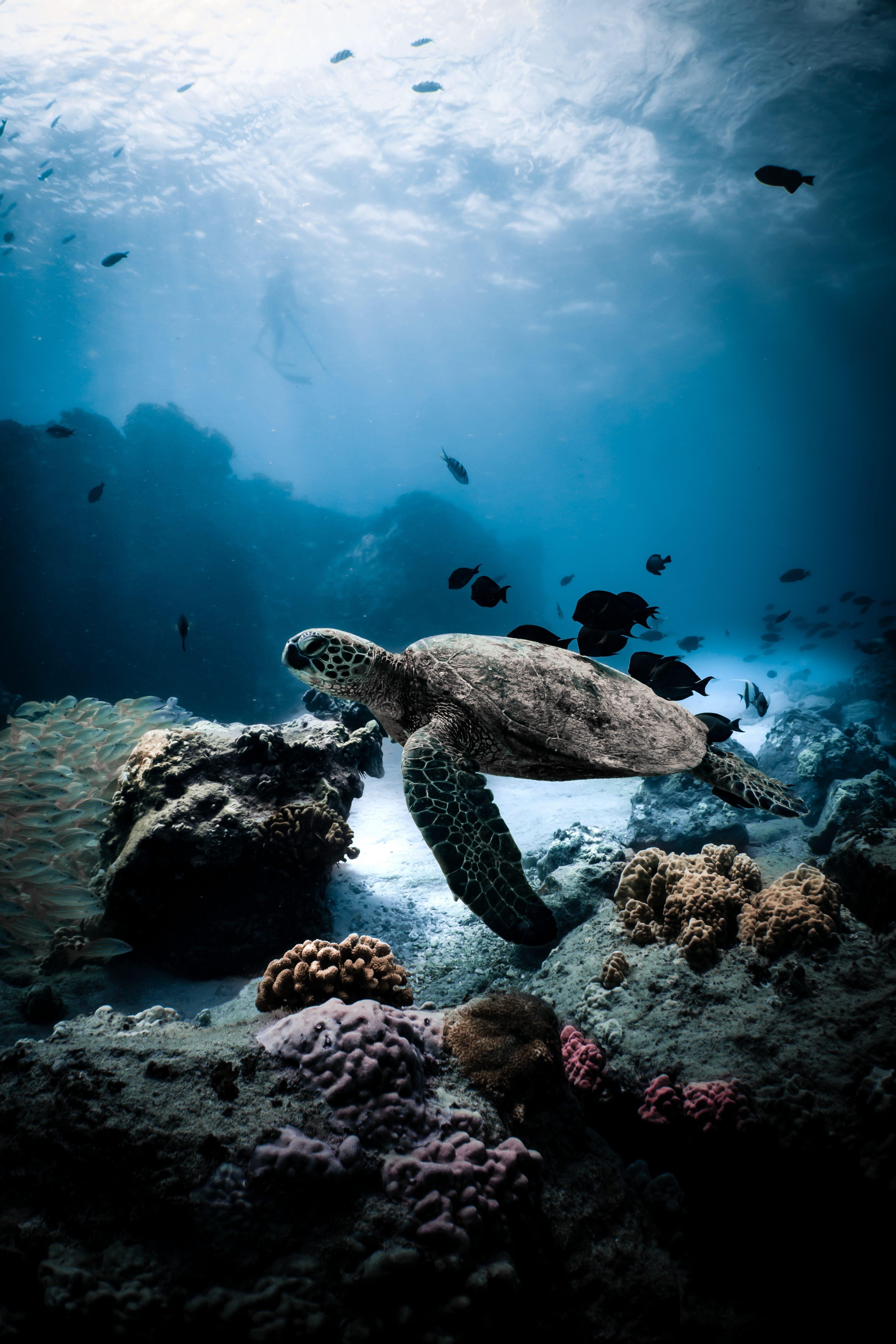
Hawaii Apex Charters: a wildlife briefing, lifeguard-certified guides and a strict no-touching rule.
Check dates