What You See at Turtle Canyon
What you see snorkeling Turtle Canyon: green sea turtles grazing, resting and rising to breathe, cleaning stations, Hawaii's state fish, rays, dolphins, whales.
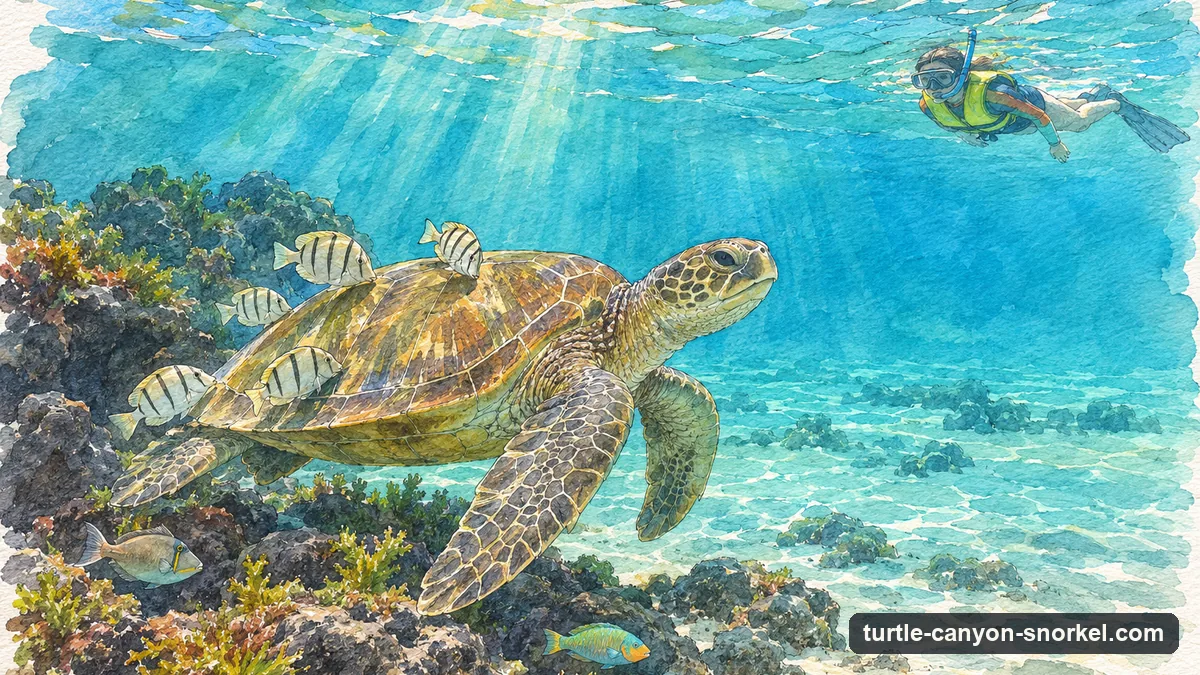
At Turtle Canyon you see Hawaiian green sea turtles, honu, from above: resting on the reef, grazing on limu, and swimming up past you to breathe, which an adult does every 15 to 30 minutes. Adults are 3 to 4 feet long in the shell. Around them swim reef fish, among them the convict tangs that clean the turtles’ shells and, with luck, the rectangular triggerfish that is Hawaii’s state fish; on the way out you may see spinner dolphins, and from November to May humpback whales. Dive Oahu’s three-hour trip gives you a wetsuit and a warm-up swim before the turtles, from $139 a person (checked November 2026).
The calendar above is Dive Oahu’s guided snorkel from its dive shop at Ala Moana: a briefing on the snorkel spots, a wetsuit and gear, a first easy swim to look at the fish, then Turtle Canyon with a guide. All snorkelers must know how to swim.
The turtles
The turtle you meet is the green sea turtle, Chelonia mydas, honu in Hawaiian. Hawaii’s green turtles belong to a population found nowhere else, and they are listed as threatened under the federal Endangered Species Act and Hawaii state law. Adults grow to 3 to 4 feet in shell length and weigh upwards of 350 pounds; as adults they are vegetarians, grazing on red and green algae (limu) and seagrass. NOAA’s turtle program notes that green turtle sightings have become a regular occurrence along Waikiki’s shallow reef, which gives them foraging grounds and places to rest.
What they do while you watch:
| You see | What is happening |
|---|---|
| A turtle lying still on the bottom | Resting. A resting adult can hold its breath for up to three hours. |
| A turtle nosing along the reef | Grazing on limu. |
| A turtle swimming up toward you | Coming up to breathe, every 15 to 30 minutes for an adult. Hold still and give it room. |
| A turtle hanging still with small fish around its shell | Being cleaned. |
| A turtle with lumps on its skin | Fibropapillomatosis, tumours caused by a turtle disease. Do not touch it; an injured turtle can be reported to NOAA’s hotline, (888) 256-9840. |
Hawaiian waters also hold hawksbill turtles (honu’ea), which are endangered and rare; NOAA asks anyone who sees one to report it to RespectWildlife@noaa.gov.
Cleaning stations
In Hawaii, green turtles visit “cleaning stations”, spots on the reef where fish nibble the parasites and dead skin off their shells. NOAA’s sanctuary program names the convict tang among the cleaners. A turtle holding still above the reef while a cloud of small fish works over its shell is at the spa. Do not swim over it: it will leave, and the fish with it.
The fish and the rest
Turtle Canyon is a reef first, so the fish come with it: tangs, triggerfish, trumpetfish and angelfish, and on a good day an eel, an octopus or a ray. The one to look for is the humuhumunukunukuapua’a, the rectangular triggerfish (Rhinecanthus rectangulus), named Hawaii’s official state fish by law in 2006. You may also see urchins on the rocks; leave them be, along with the coral.
On the boat ride you may meet spinner dolphins. Federal law bars swimming or boating within 50 yards of Hawaiian spinner dolphins within 2 nautical miles of the islands, so a good boat watches them from a distance. From November through May, humpback whales are in Hawaiian waters, with the peak from January to March, and it is illegal to approach within 100 yards of one.
How deep, how clear
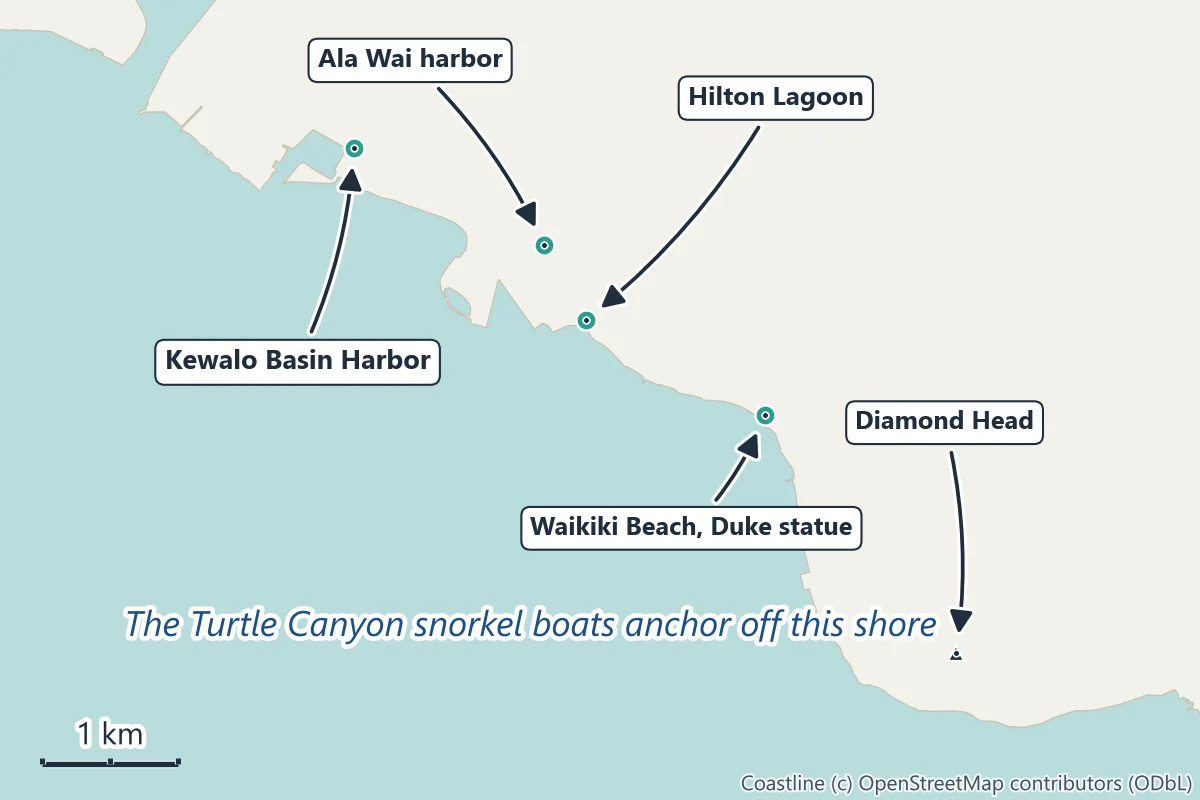
No agency describes a reef called Turtle Canyon off Waikiki. The nearest official record is the state’s Canyons Reef moorings, half a mile east of the Ala Wai harbor channel buoys: lava reefs ending in sandy seafloor, a maximum depth of 40 feet at the end of the reef, a large variety of reef fish, green sea turtles and large schools of black durgeon triggerfish, in the words of the state boating division’s Oahu mooring guidebook. Whether the tour boats use that exact spot is not on record, and you do not need the depth: you float at the surface and look down while the turtles come up to you. On a calm morning the water is clear enough to watch them from the surface; after a big swell or heavy rain it clouds. The sea off Honolulu averages about 77°F in February and 82°F in September, and a rash guard or a thin wetsuit keeps you warmer on a long swim (Dive Oahu’s trip includes a wetsuit). The best time to snorkel Turtle Canyon covers the conditions month by month.
See more in the water
- Float, do not chase. Turtles that are left alone come up to breathe; turtles that are followed go away.
- Look around as well as down. A turtle coming up to breathe may surface beside you rather than below you.
- Stay with the guide. The guides know where the turtles rest on the reef.
- Keep your fins below the surface and your hands to yourself: no touching the turtles, the coral or the urchins.
Pick your boat
Dive Oahu: Turtle Canyon Snorkel with a Wetsuit, from Ala Moana
Dive Oahu from Ala Moana: three hours, a briefing on the spots, a wetsuit, a first easy swim, then Turtle Canyon with a guide.
Check dates →Hawaii Ocean Charters: Small-Group Turtle Canyon Snorkel with a Guide in the Water
Hawaii Ocean Charters from Kewalo Basin: 60 minutes in the water with a guide and a safety diver.
See the hour-long snorkel →Hawaii Apex Charters: Turtle Canyon Snorkel for Six, Hands-Off
Hawaii Apex Charters: six guests at most, lifeguard-certified guides, a strict hands-off rule and a photo and video package.
See the six-guest boat →Prices, ratings and review counts from the listings (GetYourGuide checked November 2026). Operators price by date and season, so treat the figures as the shape of the market, not a quote.
More Trips with Open Dates
More Turtle Snorkels Off Waikiki with Open Dates
Turtle snorkels and catamarans with live availability. Times and cancellation terms are on each listing.
A Wetsuit, a Warm-Up, Then the Turtles
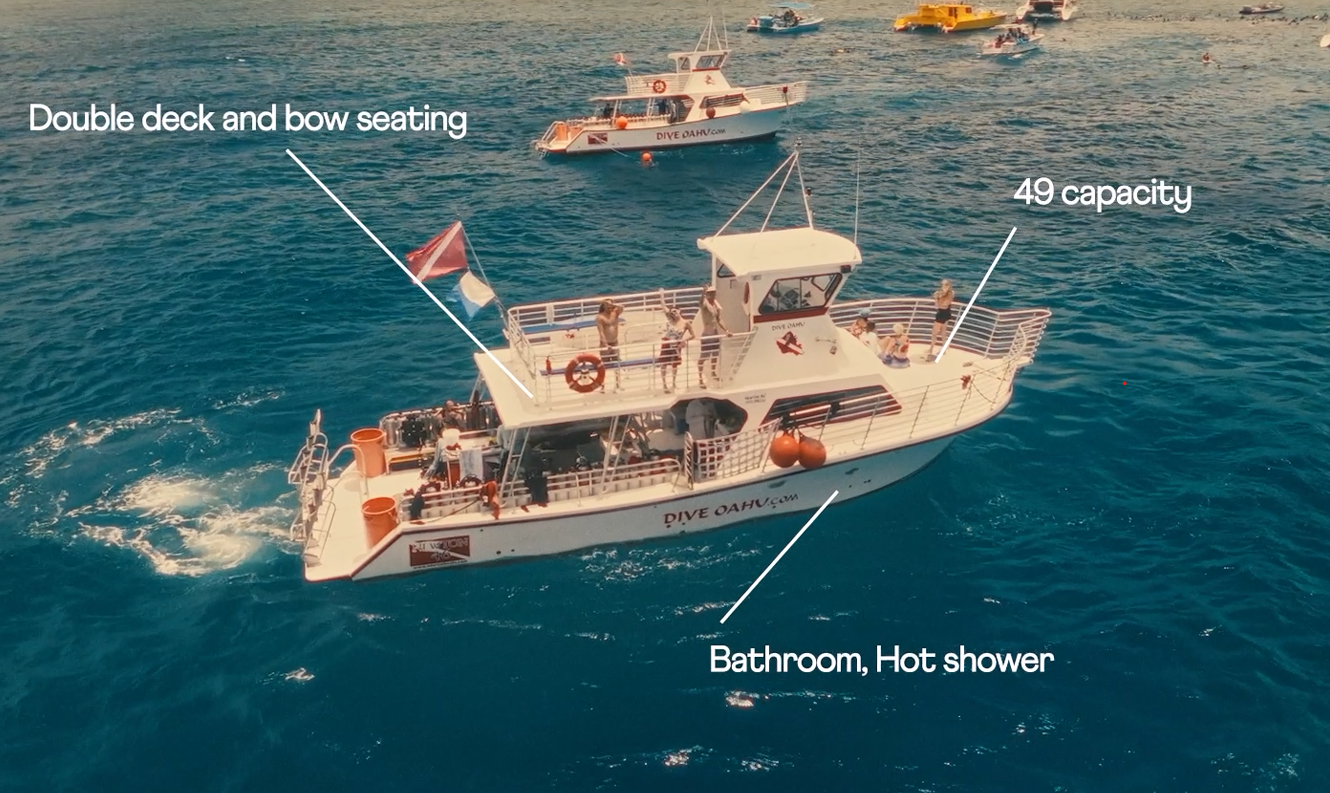
Dive Oahu from Ala Moana: three hours, a briefing on the spots and a guide at Turtle Canyon.
Check dates